Overview
I have a special interest in the surgical management of a blocked nose.
If you suffer from nasal obstruction and have had one or more surgeries in the past with no improvement, do not despair. New advances in minimally invasive nasal procedures are showing a higher success rate and are very promising.
Breathing through your nose matters because it filters, warms, and moistens the air you breathe in. It also helps your lungs absorb oxygen efficiently and protects your overall health. When your nose is blocked, breathing becomes harder, and sleep and daily life can suffer.
Deviated Nasal Septum (DNS)
A deviated nasal septum occurs when the thin wall of cartilage and bone that divides the inside of your nose into two passages is shifted to one side, making one passage narrower than the other. Many people have some degree of deviation without knowing it. It can be present from birth or result from an injury to the nose, and it may worsen with age.
Treatment
Treatment is only needed when symptoms are bothersome.
- Surgical
- Septoplasty is the standard operation. The surgeon straightens and repositions the septum, usually through the nostrils with no external cuts, under anesthesia. Recovery generally takes a few weeks.
- In septoplasty, nasal packing is most often unnecessary, and when the patient wakes from anesthesia, he can breathe easily through his nose, ensuring a safe recovery.
When to see a doctor
- Consult an ENT specialist if you have ongoing difficulty breathing through your nose, frequent nosebleeds, snoring, or recurring sinus infections.
TURBINATE HYPERTROPHY
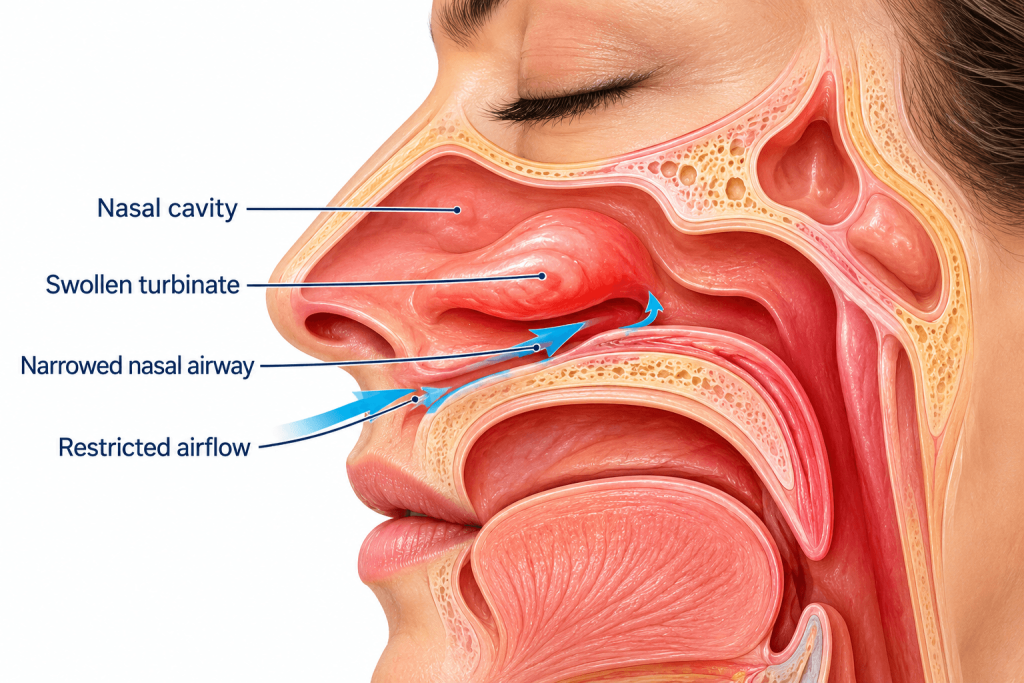
Turbinates are three pairs of bony, curved structures covered with soft tissue that run along the side walls inside your nose. Their job is to warm, humidify, and filter the air you breathe. Turbinate hypertrophy (enlarged turbinates) means they have become swollen, either from the soft tissue lining or from the underlying bone, which narrows the airway. The lower pair, the inferior turbinates, are the ones most often affected.
Common causes
- Allergies (the most common cause)
- Chronic sinus inflammation or repeated infections
- Irritants such as smoke, pollution, or strong fumes
- Overuse of decongestant nasal sprays
- Hormonal changes, such as pregnancy
- A deviated septum, where the turbinate on the wider side often enlarges to compensate
Symptoms
- Nasal blockage or stuffiness, often alternating between sides
- Difficulty breathing through the nose
- Runny nose or postnasal drip
- Snoring or disturbed sleep
- Mouth breathing and dry mouth
- Reduced sense of smell
- Facial pressure or headaches
- Frequent sinus infections
Treatment
- Medical or surgical reduction (Turbinectomy). There are many noninvasive techniques to promote a speed recovery. Usually no nasal packing is needed.
Nasal Polyps
Nasal polyps are soft, painless, non-cancerous growths that form on the lining of the nose or sinuses. They look like small teardrops or grapes and develop from long-standing inflammation of the nasal and sinus lining. They are different from enlarged turbinates, which are normal structures that have become swollen. Small polyps may cause no symptoms, while larger ones or clusters can block the nasal passages.
Medical or surgical removal
- Blocked or stuffy nose that does not clear
- Runny nose
- Reduced or lost sense of smell, and often reduced taste
- Facial pressure or fullness, sometimes headaches
- Snoring or disturbed sleep
- Mouth breathing
- Frequent sinus infections
- Pressure around the forehead or upper teeth
Treatment
- Medical or surgical removal (Nasal Polypectomy) and usually no need for nasal packing.
Nasal Valve Collapse
The nasal valve is the narrowest part of your nasal airway, located in the front half of the nose, just inside the nostrils. Nasal valve collapse happens when the walls of this area are weak or too narrow and move inward as you breathe in, narrowing or blocking the airway. It can affect one or both sides.
Common causes
- Previous nose surgery, especially rhinoplasty, where too much cartilage was removed
- Injury to the nose
- Natural weakness of the cartilage, which becomes more common with age
- A deviated septum
- Congenital narrowness, or facial paralysis that weakens the nasal muscles
- Chronic inflammation or overuse of decongestant sprays
Symptoms
- Difficulty breathing through the nose, especially when inhaling
- Nostrils that pull inward or look pinched when breathing in
- Blockage that is worse during exercise or deep breaths
- Congestion that does not improve with sprays or allergy medicines
- Nasal crusting or nosebleeds
- Trouble sleeping or snoring
- A feeling that one side is always blocked
- A simple at-home test is the Cottle maneuver: gently pull the cheek outward to widen the nostril. If your breathing suddenly improves, valve collapse may be involved, although only a doctor can confirm this.
When to see a doctor
See an ENT specialist if you experience persistent nasal blockage, difficulty breathing, frequent sinus infections, or sleep disturbances, especially when medications provide little relief.