The Ear
The ear is the sensory organ responsible for hearing (detecting sound) and balance (maintaining equilibrium and body position).
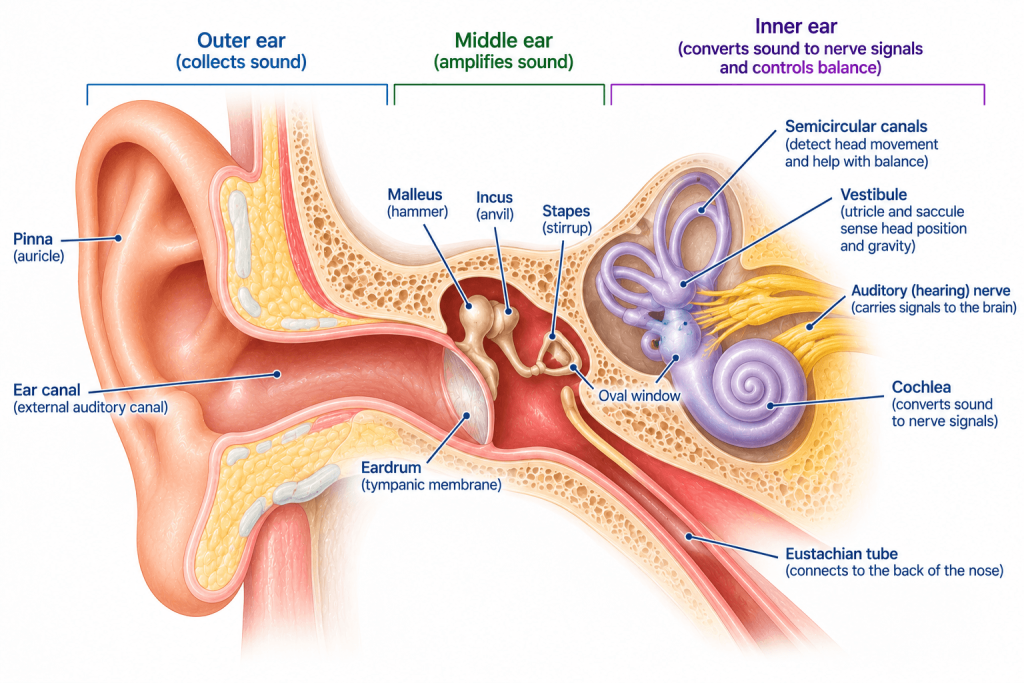
The ear is composed of three parts: the outer ear (collects sound), the middle ear (amplifies sound), and the inner ear (converts sound into nerve signals and controls balance).
The eardrum (tympanic membrane) is a thin membrane that vibrates when sound waves strike it; it marks the boundary between the outer ear and the middle ear. The Eustachian tube connects the middle ear to the back of the nose (the nasopharynx) and equalizes air pressure in the middle ear.
Perforated Eardrum (Hole in the Eardrum)
A hole or perforation in the eardrum (ruptured tympanic membrane) often heals on its own within a few weeks to 2 months, without medical intervention.
Treatment depends on the cause, the size of the hole, and whether an infection is present.
Surgical treatment: myringoplasty (surgical repair of the eardrum).
Types of Otitis Media
Acute otitis media
A sudden infection with fluid and a red, bulging eardrum. It causes ear pain, fever, irritability, trouble sleeping, and sometimes reduced hearing.
Recurrent acute otitis media
Repeated episodes of acute infection, usually 3 or more in 6 months or 4 or more in a year.
Otitis media with effusion ("glue ear")
Fluid stays behind an intact eardrum without signs of acute infection. It causes a blocked feeling and reduced hearing, often without pain.
Chronic suppurative otitis media
A long-lasting infection with a hole in the eardrum and ear discharge, usually lasting more than 6 weeks.
Most Common Cause of Hearing Loss in Children
The most common cause is otitis media with effusion (serous otitis media, or “glue ear”), which is fluid trapped in the middle ear. It is the most common cause of hearing loss in children overall. It is conductive and it is usually temporary.
Visible bubbles in the middle ear indicate that non-infected fluid has accumulated behind the eardrum (tympanic membrane) and that air is starting to re-enter and mix with the fluid.
The fluid and bubbles can cause uncomfortable or unusual sensations that a young child may find bothersome or have trouble describing. When the bubbles move as your child swallows or yawns, your child may hear or feel a crackling, clicking, or popping sound inside the ear. The fluid creates a clogged or blocked sensation, similar to the feeling of having water trapped in the ear after swimming or during an airplane flight
Why it is so common
- Children have short, narrow, horizontal Eustachian tubes that drain poorly.
- Frequent colds and upper respiratory infections block the tube.
- Enlarged adenoids and allergies add to the blockage.
- Fluid collects behind the eardrum, so it cannot vibrate well. This causes a mild to moderate conductive hearing loss.
Clues in a child
- Not responding when called, or turning the TV up loud
- Inattention in class and poor school performance
- Delayed or unclear speech
- Mild ear discomfort (often with no pain or fever)
Treatment
- Watchful waiting ("wait and see")
- Medical treatment
- Surgical treatment: myringotomy, which involves inserting a small tube into the eardrum and aspirating the fluid from the middle ear. Adenoidectomy is sometimes carried out at the same time.
Facial Nerve Paralysis Due to Ear Infection
Loss of function of the facial nerve, which controls facial movement, caused by infection or inflammation of the ear. The result is weakness or paralysis of the muscles of facial expression on the same side of the face.
The facial nerve passes through the ear. Because it lies so close to the middle ear and the mastoid bone, infection there can easily reach it. The bony covering of the nerve is thinnest in children, and some people have natural gaps in it.
Investigations
- Otoscopy
- Audiometry and tympanometry
- CT scan of the ear for bone erosion or infection
- MRI if a nerve lesion or intracranial spread is suspected
- Ear discharge culture and blood sugar
Ear symptoms
- Pain
- Discharge
- Hearing loss
- Fever
Management
- Voice rest and voice therapy with a speech-language pathologist
- Treatment of reflux and avoidance of smoking and irritants
- Surgical removal (microlaryngoscopy) using surgical microscope under general anesthesia when polyps persist or affect the voice significantly
- Voice therapy after surgery to prevent recurrence
- Although polyps are benign, any persistent vocal cord lesion should be examined carefully, because some cancers can look similar.
Sudden Hearing Loss
Hearing loss that develops rapidly, over a few hours to 3 days. The term usually refers to sudden inner ear hearing loss. It most often affects one ear and is considered a medical emergency, because early treatment gives the best chance of recovery.
Signs and symptoms
- Sudden loss of hearing, often noticed on waking or when using the phone
- A feeling of fullness or blockage in the ear
- Tinnitus (ringing or buzzing)
- Dizziness or vertigo, with nausea or loss of balance in some cases
- Sounds seem muffled or distorted, with difficulty understanding speech
- Warning signs needing urgent attention: facial weakness, severe headache, weakness elsewhere in the body, double vision, fever, or neck stiffness.
Treatment
- Treatment: treatment should start as early as possible, ideally within 72 hours and no later than 2 weeks.
Diagnosis
- History and ear examination (otoscopy) to rule out wax, infection, or eardrum damage
- Pure-tone audiometry, which confirms the diagnosis and the degree of loss
- MRI (with contrast) to look for an acoustic nerve lesion or other lesion
Vertigo and Imbalance from the Ear
Vertigo is the false sensation that you or your surroundings are spinning or moving when there is no actual movement. Imbalance (disequilibrium) is unsteadiness or difficulty keeping balance when standing or walking.
How the ear controls balance
- Semicircular canals: detect head rotation
- Utricle and saccule (in the vestibule): detect straight-line movement, head tilt, and gravity
- Vestibular nerve: carries signals to the brainstem and cerebellum
- The brain combines these signals with input from the eyes and from body position sensors (muscles and joints). If one inner ear sends faulty or unequal signals, the brain receives a mismatch and produces vertigo.
Ear causes of vertigo
Benign paroxysmal positional vertigo (BPPV)
BPPV is the most common cause. It is an inner ear disorder that causes sudden, brief episodes of spinning dizziness (vertigo) triggered by specific changes in head position.
Cause: tiny calcium crystals break loose from the utricle and move into a semicircular canal (usually the posterior canal).
Features: brief spinning (less than 1 minute) triggered by head position changes, such as rolling over in bed, looking up, or bending down. There is no hearing loss.
Ménière's disease
Cause: excess fluid pressure (endolymphatic hydrops) in the inner ear.
Features: attacks of vertigo lasting 20 minutes to several hours, plus fluctuating hearing loss, tinnitus, and ear fullness.
Vestibular neuritis and labyrinthitis
Cause: usually a viral infection after a cold or flu.
Vestibular neuritis: sudden severe vertigo lasting days, with nausea and vomiting, but normal hearing.
Labyrinthitis: the same symptoms plus hearing loss and tinnitus.
Acoustic Neuroma
An acoustic neuroma (historically called a vestibular schwannoma) is a benign (non-cancerous), usually slow-growing tumor that develops on the eighth cranial nerve (the vestibulocochlear nerve). This nerve runs from the inner ear to the brainstem and is directly responsible for transmitting the senses of hearing and balance
This is only general information that does not replace doctor consultation
Ear Trauma
Ear trauma means any injury to the ear.
Get urgent medical care if
- The ear injury follows a head injury
- There is clear, watery fluid or heavy blood coming from the ear
- You have sudden hearing loss, severe dizziness, or repeated vomiting
- One side of the face is drooping or weak
- You see bruising behind the ear
- A button battery or other object is stuck in the ear (this is an emergency, as batteries can burn tissue quickly)
- The outer ear is swollen, tight, and painful after a blow
Prevention
- Don’t use cotton swabs inside the ear canal. The ear mostly cleans itself.
- Use hearing protection around loud noise
- Equalize pressure when flying or diving (swallowing, yawning), and avoid flying or diving with a bad cold.
- Keep earbud volume moderate.
- This is general information, not a substitute for a medical exam.