What is the larynx?
The larynx, or voice box, sits at the top of the windpipe (trachea) in the front of the neck. It is built from cartilage, muscles, and soft tissue.
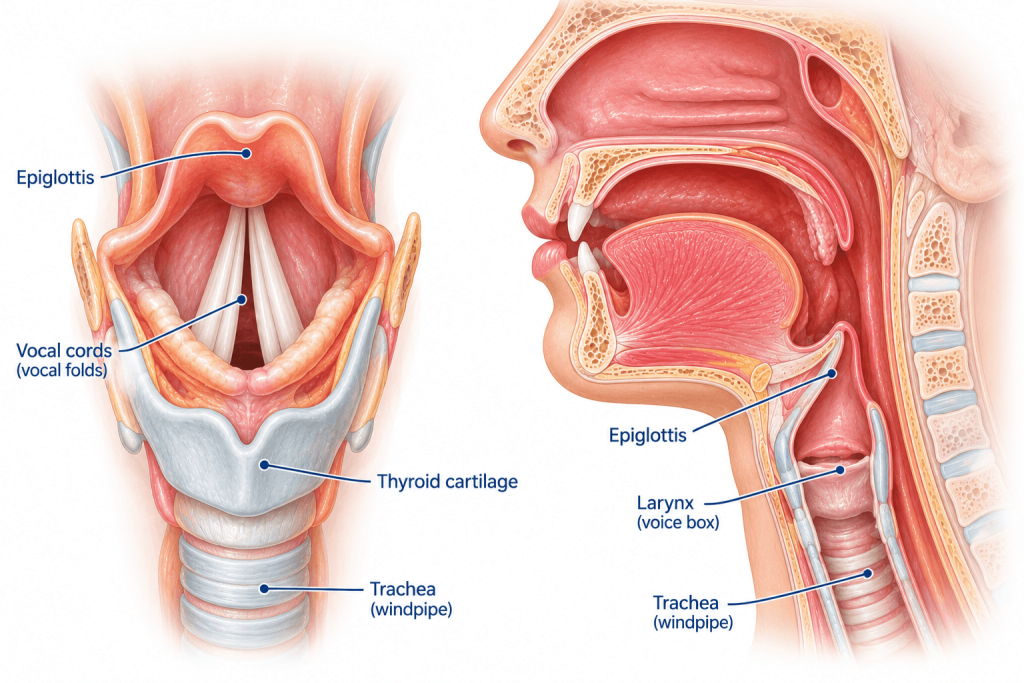
Larynx jobs
Protecting the airway
It closes during swallowing so food and liquid do not enter the lungs.
Breathing
It forms the opening through which air passes to and from the lungs.
Producing voice
Air from the lungs passes between the vocal cords, making them vibrate to create sound.
How the larynx is examined
Laryngoscopy
A flexible or rigid scope passed through the nose or mouth lets the doctor see the larynx in the clinic.
Videostroboscopy
A flashing light shows the vocal fold vibration in apparent slow motion, revealing subtle abnormalities.
Microlaryngoscopy
The larynx is examined under an operating microscope with the patient under general anesthesia, allowing precise assessment, biopsy, and treatment.
Contact endoscopy (microendoscopy)
A rigid endoscope placed gently against the vocal fold surface, usually after staining with a dye such as methylene blue, magnifies the tissue enough to see individual cell layers.
Biopsy
Examination of a tissue sample under a microscope remains the definitive way to confirm a diagnosis.
Hoarseness (dysphonia)
Hoarseness is a change in voice quality. The voice may sound rough, raspy, breathy, strained, weak, or lower or higher in pitch. It is a symptom, not a disease, and it signals that the vocal cords are not vibrating normally.
Common causes
- Acute laryngitis from a cold or voice overuse (usually temporary)
- Laryngopharyngeal reflux (stomach acid irritating the throat)
- Vocal cord nodules, polyps, or cysts
- Vocal cord paralysis or nerve injury
- Chronic irritation from smoking, alcohol, or dry air
- Precancerous changes and laryngeal cancer
When to see a doctor
Hoarseness that lasts more than 2 to 4 weeks should be evaluated, especially in smokers and heavy drinkers. Seek prompt care for hoarseness with any of the following:
- Difficulty breathing or noisy breathing (stridor)
- Difficulty or pain with swallowing
- Coughing up blood
- A swellings in the neck
- Persistent ear pain on one side
- Unexplained weight loss
Vocal cord polyps
Vocal cord polyps are benign (non-cancerous) growths on the vocal folds. They are usually found on one side and may be soft and blister-like or firmer and stalk-like.
Causes and risk factors
- Voice abuse or strain (shouting, prolonged speaking)
- Smoking
- Reflux
- Single episode of intense vocal trauma
Symptoms
- Hoarseness
- Breathy or rough voice
- Vocal fatigue
- Sensation of needing to clear the throat.
Treatment
- Voice rest and voice therapy with a speech-language pathologist
- Treatment of reflux and avoidance of smoking and irritants
- Surgical removal (microlaryngoscopy) using surgical microscope under general anesthesia when polyps persist or affect the voice significantly
- Voice therapy after surgery to prevent recurrence
- Although polyps are benign, any persistent vocal cord lesion should be examined carefully, because some cancers can look similar.
VOCAL CORD NODULES
Vocal cord nodules are small, benign, callus-like growths on the vocal folds, caused by repeated voice strain or misuse, that lead to hoarseness and vocal fatigue.
Treatment of vocal cord nodules is usually conservative, and most cases improve without surgery.
In children nodules often improve on their own, especially after puberty, so treatment usually focuses on voice therapy and reducing vocal strain.
Treatment of vocal cord nodules mainly involves voice therapy and voice rest, along with reducing risk factors such as reflux and smoking. Surgery is reserved for cases that do not improve with conservative treatment.”
Vocal cord edema and shortness of breath
Vocal cord edema is swelling of the vocal folds caused by fluid in the tissue. Mild swelling mainly changes the voice. Marked swelling, particularly of the larynx as a whole, can narrow the airway and cause shortness of breath, which can be an emergency.
Symptoms
- Low, rough, or hoarse voice, often lower than usual in women
- Vocal fatigue and a feeling of a swelling or fullness in the throat
- Noisy breathing (stridor) or wheezing
- Shortness of breath, especially when lying down, speaking, or exercising
- Difficulty swallowing , and swelling of the lips, tongue, or face in allergic swelling
Causes
- Chronic irritation: smoking is the main cause of edema, a long-standing, fluid-filled swelling of both vocal folds. Reflux, voice overuse, and dry or polluted air also contribute.
How it is diagnosed
- Review of symptoms, smoking history, medicines, allergies, and reflux
- Laryngoscopy(uses a scope to examine your larynx ) and videostroboscopy to see the swelling and how the folds move
- Tests for allergy, thyroid function, or other causes when suggested by the history
- Imaging when the cause of breathlessness is unclear
Laryngeal cancer
Cancer of the larynx most often develops from the cells lining the vocal folds. The main risk factors are tobacco use and heavy alcohol consumption, which act together to multiply the risk. Occupational exposures, and reflux may also contribute.
Prevention
- Avoid tobacco, limit alcohol, and have persistent hoarseness checked promptly.
Treatment
- Treatment depends on the stage and location. Early cancers are often treated with radiation therapy or minimally invasive surgery (such as laser surgery), with high cure rates and good voice preservation. Advanced cancers may need combined treatment such as chemotherapy ( often is called chemo and is a medical treatment that uses powerful drugs to destroy fast-growing cells in the body), radiation, surgery and rehabilitation for voice and swallowing
Vocal cord paralysis
Vocal cord paralysis happens when one or both vocal folds cannot move normally because of nerve damage. The folds then fail to close fully for voice and swallowing, or fail to open fully for breathing. It is a symptom of an underlying problem, so the cause should always be investigated.
Symptoms
- Hoarse, weak, or breathy voice, and a voice that tires easily
- Running out of breath when speaking
- Choking or coughing when eating or drinking, which can lead to aspiration
- Noisy breathing or breathing difficulty, particularly in bilateral paralysis
- Loss of pitch range or inability to project the voice
- Seek urgent care for breathing difficulty, noisy breathing, or repeated choking on food or liquids.
How it is diagnosed
- Laryngoscopy and videostroboscopy ( slow movements of vocal folds ) to see how the folds move
- Imaging such as CT or MRI of the neck and chest, to look for a cause along the path of the nerve
- Swallowing assessment when choking or coughing with meals is reported
Treatment
Treatment depends on the individual case and varies from case to case.
Foreign bodies in the larynx
A foreign body in the larynx is an object, usually food, that becomes lodged in or near the voice box. It can partly or completely block the airway, so it is always an emergency.
Who is at risk
- Young children (especially under 3): they put objects in their mouths and do not chew well. Common causes are nuts, seeds, grapes, hard candy, pieces of hot dog, small toys, and balloon fragments.
- Adults: large pieces of poorly chewed food, fish bones, and dentures. Alcohol, sedative medicines, dental work, and conditions that affect swallowing or alertness raise the risk.
Treatment
- Removal is done by an ENT surgeon or another airway specialist, usually under general anesthesia with a rigid endoscope.
Possible complications
- Airway swelling, injury to the vocal folds or surrounding tissue, lung infection (aspiration pneumonia), and in severe cases, oxygen deprivation.
- Lung infection (aspiration pneumonia is bacterial lung infection that happens when you accidentally inhale (aspirate) foreign matter-such as food, liquid, saliva, vomit, or stomach contents-into your lungs or lower airways)
Laryngeal trauma
Laryngeal trauma is injury to the voice box from an outside force or from something placed inside it. It is uncommon, but it can threaten the airway and permanently change the voice, so early assessment matters.
How it is diagnosed
- Immediate assessment of the airway and breathing
- Flexible laryngoscopy to look at the folds, swelling, and tears
- CT scan of the neck to check for fractures of the laryngeal cartilages
Gastroesophageal Reflux
Gastroesophageal reflux disease (GERD) is a chronic digestive disorder that occurs when stomach acid or nonacidic stomach contents repeatedly flow back up into the esophagus, larynx and throat irritating or damaging their lining.
The tissue of the larynx is much more delicate than the esophagus and stomach and has little protection against acid. Even small amounts of reflux can inflame it.
When to see a doctor
A voice change that lasts more than a few weeks is worth checking. Most causes are benign and treatable, and when cancer is the cause, early detection greatly improves outcomes.
This content is for general information only and does not replace professional medical advice, diagnosis, or treatment. Consult a qualified healthcare provider about any health concern.